The complete Answer Engine Optimization guide for 2026. Learn strategies for getting your SaaS company cited by ChatGPT, Perplexity, Claude, and Google AI Overviews. Proven strategies, real examples, and implementation framework.
Okay so how on earth do LLMs work?
First things first.
To appear in LLMs, understand how they function. When you ask ChatGPT for current SaaS pricing (like Slack), it lacks training data. Instead, it fetches information from the web via citations/sources—your content placement opportunity.
Consider Perplexity: many assume it's simply a Google Search frontend. But that's not the case. Perplexity uses its own web crawler, PerplexityBot, indexing independent internet data.
While Perplexity references Google's and Bing's rankings to inform results, it doesn't solely depend on their data. Aravind Srinivas noted that while Perplexity uses Google's results, only when AI deems them the best link quality indicator. They don't copy Google's search results. Perplexity has native AI-powered search functionality, not a Google wrapper.
Let's Compare: Google vs Perplexity vs ChatGPT
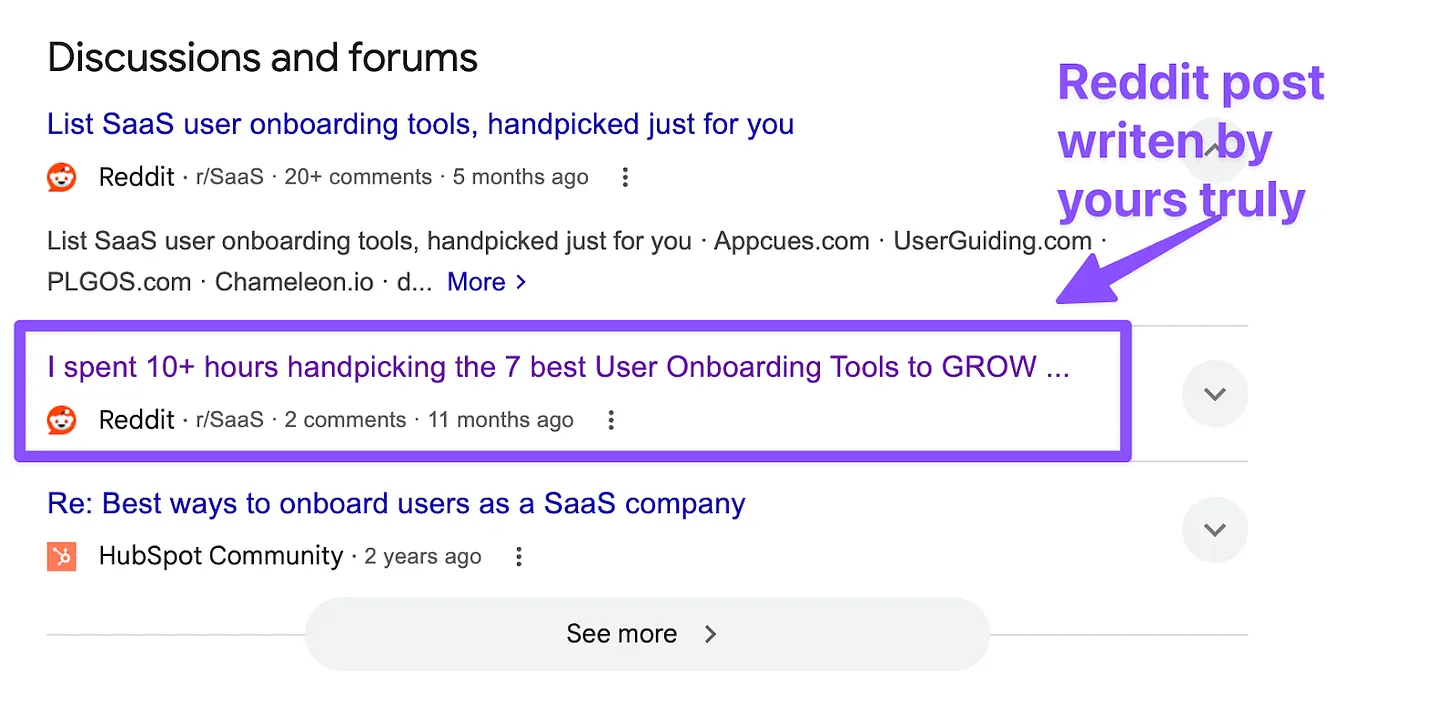
Searching "best onboarding tools for B2B SaaS" on Google displays an AI overview plus Reddit discussions below.
Reddit is a strong ranking source for Google's AI overview.
Two critical factors:
- Domain authority of blogs (Userlist, Pendo)
- Forums/communities discussing best tools
Tools at this intersection get picked up by LLMs.
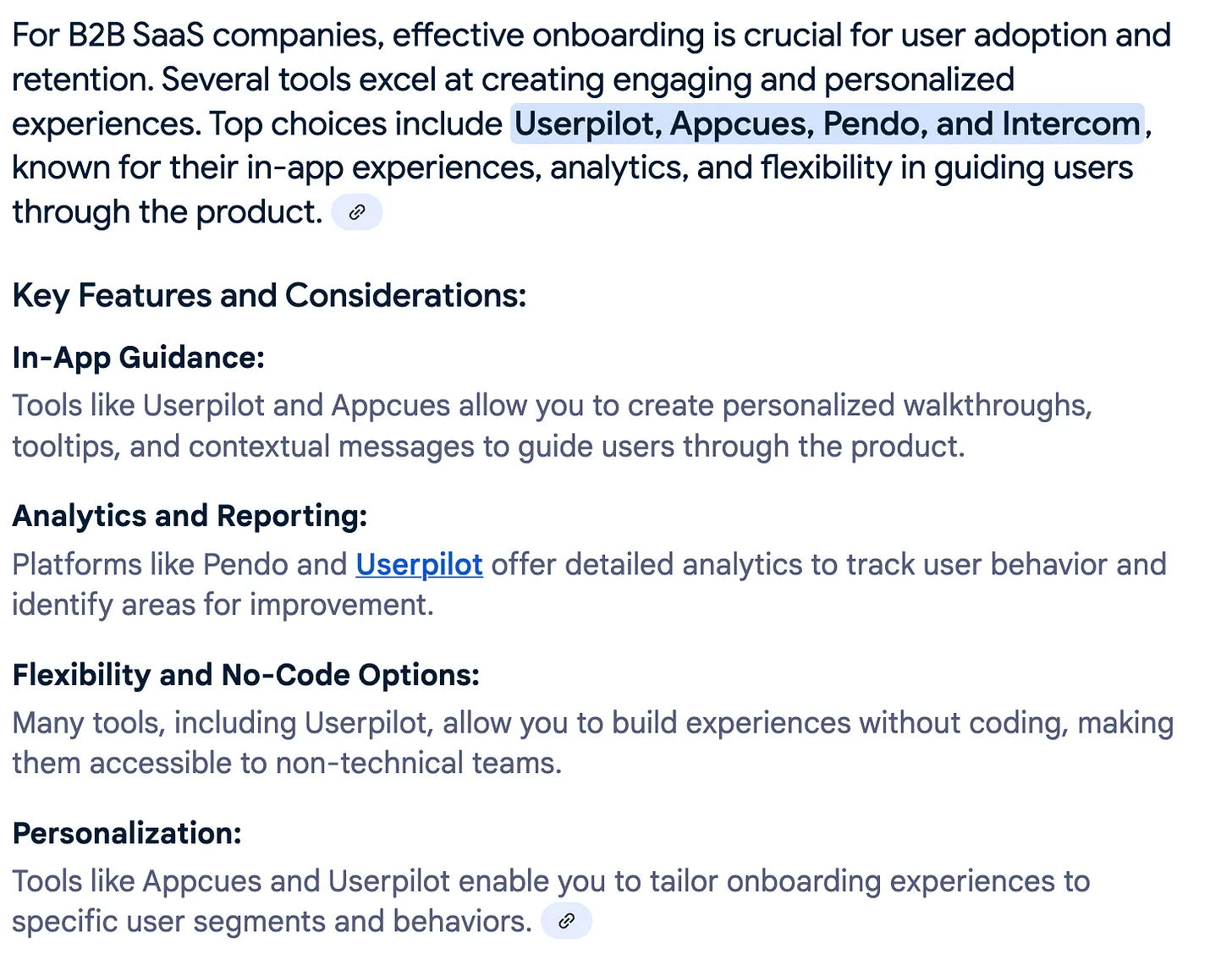
Case in point: A Reddit post featuring Pendo and Appcues now appears in AI overviews. This stems from the Google-Reddit partnership announced February 2024 (worth $60 million annually), enabling Reddit threads on Google's first page with AI overview citations.
Now let's look at Perplexity
Perplexity's sources differ noticeably from Google's. While top 4 entries overlap, ProductFruits, Intercom, and Moxo appear only on Perplexity—missing from Google entirely.
This proves Perplexity isn't just a Google frontend. It sources Google data but isn't solely dependent on it.
What about ChatGPT?
ChatGPT features standard sources with interesting differences. Like Google, it picks Reddit threads.
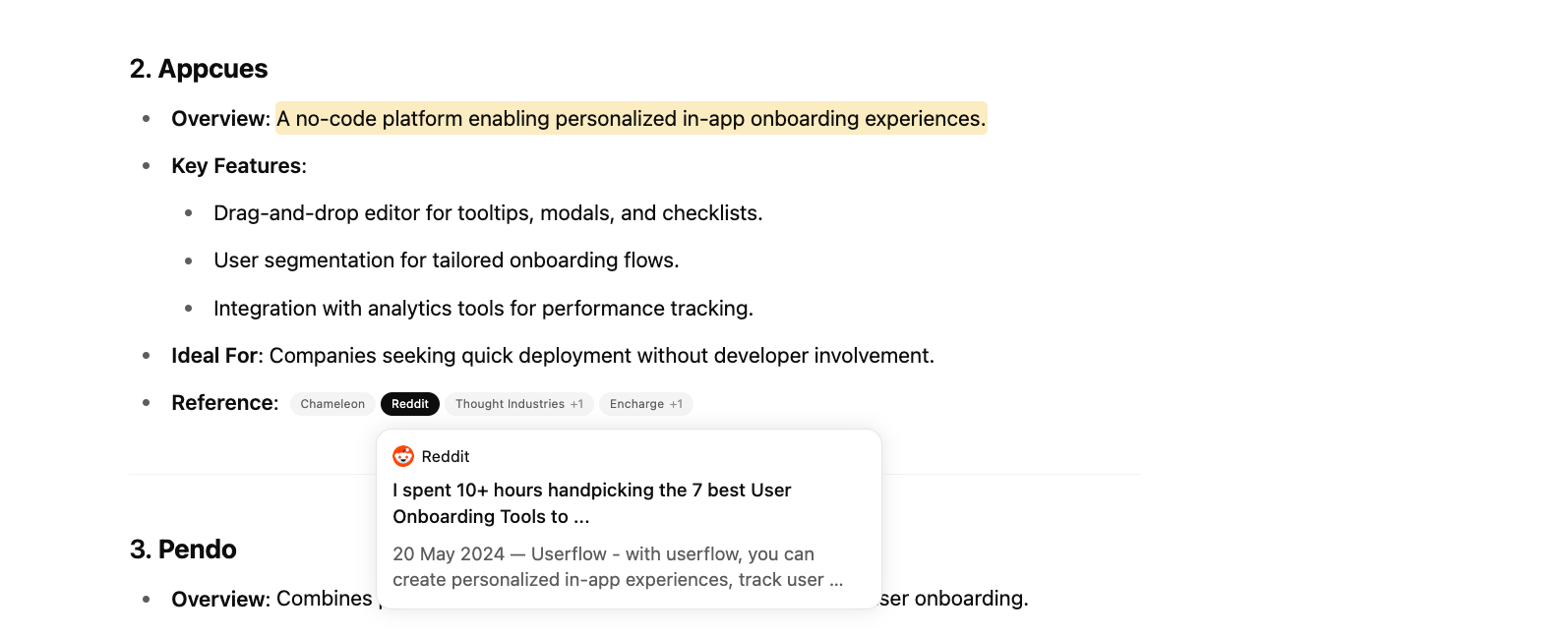
Reddit posts get picked up by both ChatGPT and Google, confirming that Reddit posting alongside blog publishing helps LLM visibility.
Companies like Whatfix and Coursebox appear on ChatGPT but not Perplexity or Google.
How LLMs Score Content
When querying an LLM, AI algorithms score content by relevance—going beyond keyword matching.
For Perplexity's "Which is the best product onboarding software?" the processing looks like:
- Step 1: Identify keywords ("best", "product onboarding", "software")
- Step 2: Semantic analysis ("best" = top-rated, most effective, highest quality)
- Step 3: Topical relevance (app development, user engagement, customer communication, recent awards/reviews)
- Step 4: Score available content by relevance
Make Sure Your Content is Structured for LLMs
With LLM mechanics understood, facilitate their content discovery through optimization—similar to SEO's meta-titles and alt-tags.
1: Add Clear Metadata
LLMs rely on structured data for comprehension, entity recognition, and categorization. Without clear metadata, AI misinterprets or fails associating content with queries.
Use Schema.org markup to provide explicit content meaning signals, increasing LLM reference accuracy.
| Schema Type | Use Case |
|---|---|
| Article (schema:Article) | Blog posts, news articles, general web content |
| FAQPage (schema:FAQPage) | Structured FAQs for direct AI Q&A extraction |
| HowTo (schema:HowTo) | Step-by-step tutorials and guides |
| Product (schema:Product) | eCommerce and SaaS content |
| Organization (schema:Organization) | Brand credibility and authoritative mentions |
| Person (schema:Person) | Personal branding and expert recognition |
Use Google's Structured Data Markup Helper. Select schema type, input URL, tag page elements, generate JSON-LD HTML.
JSON-LD Example:
{
  "@context": "https://schema.org",
  "@type": "Person",
  "name": "John Doe",
  "jobTitle": "Software Engineer",
  "worksFor": {
    "@type": "Organization",
    "name": "Example Tech"
  }
}
Fun fact: JSON-LD fine-tunes ChatGPT LLM models.
2: Optimize for LLMs.txt
For AI startups with documentation/knowledge bases, leverage llms.txt files—web standards helping websites communicate with LLMs like ChatGPT, Gemini, and Claude.
It's robots.txt for LLMs. While robots.txt controls search engine crawling, llms.txt makes content understandable for AI systems.
How to Get Your Content Referenced by LLMs
With technical optimization complete, here's sourcing/mention strategy.
1. Write Something Worth Reading
Example of an article ranking on ChatGPT:
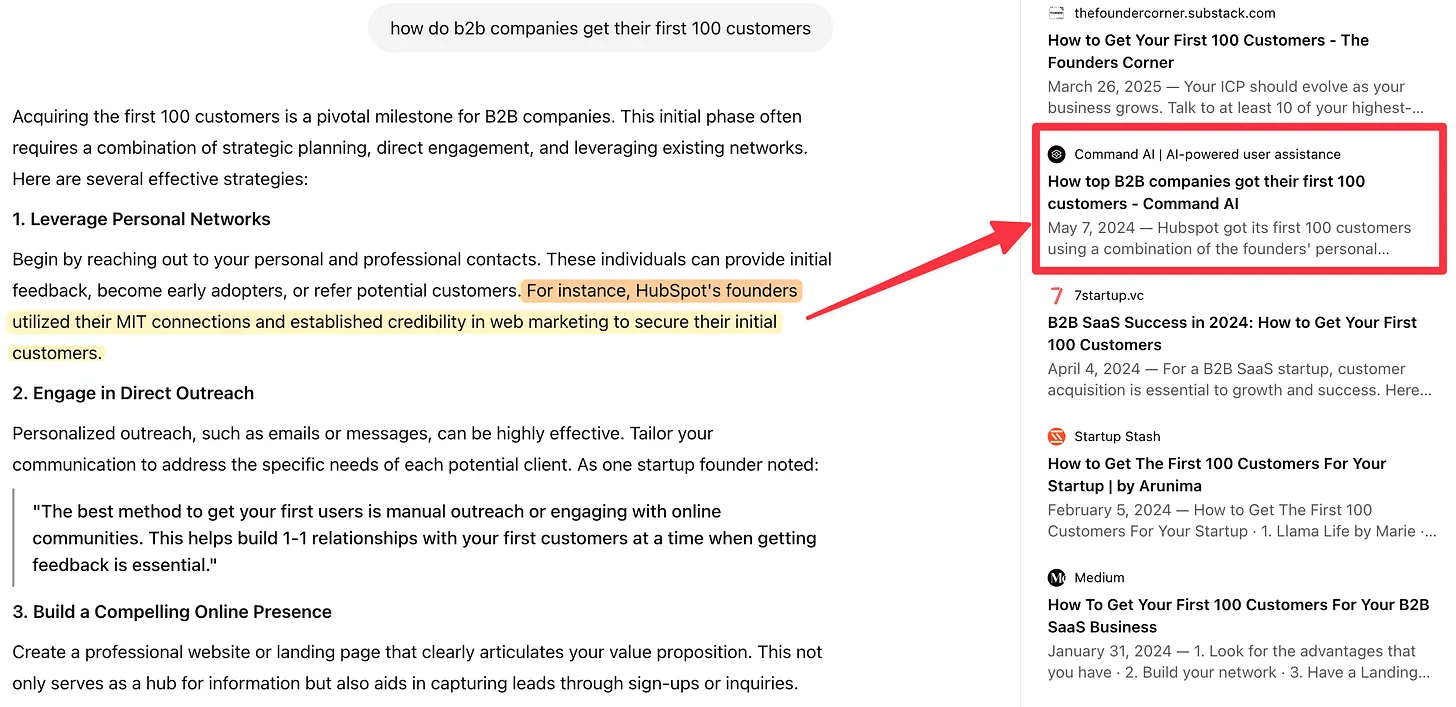
Why this works:
- Answers direct founder questions posed to LLMs
- Engaging, actionable tactics
- Aligned with user query intent
You must ensure answer relevance to queries—achievable through compelling, readable content.
2. Share It Across the Internet
After crafting quality content, build digital PR backlinks via Reddit.
Reddit digital PR signals content is:
- Useful
- Unique
- Not AI-generated
Authentic sources with personal stories build credibility.
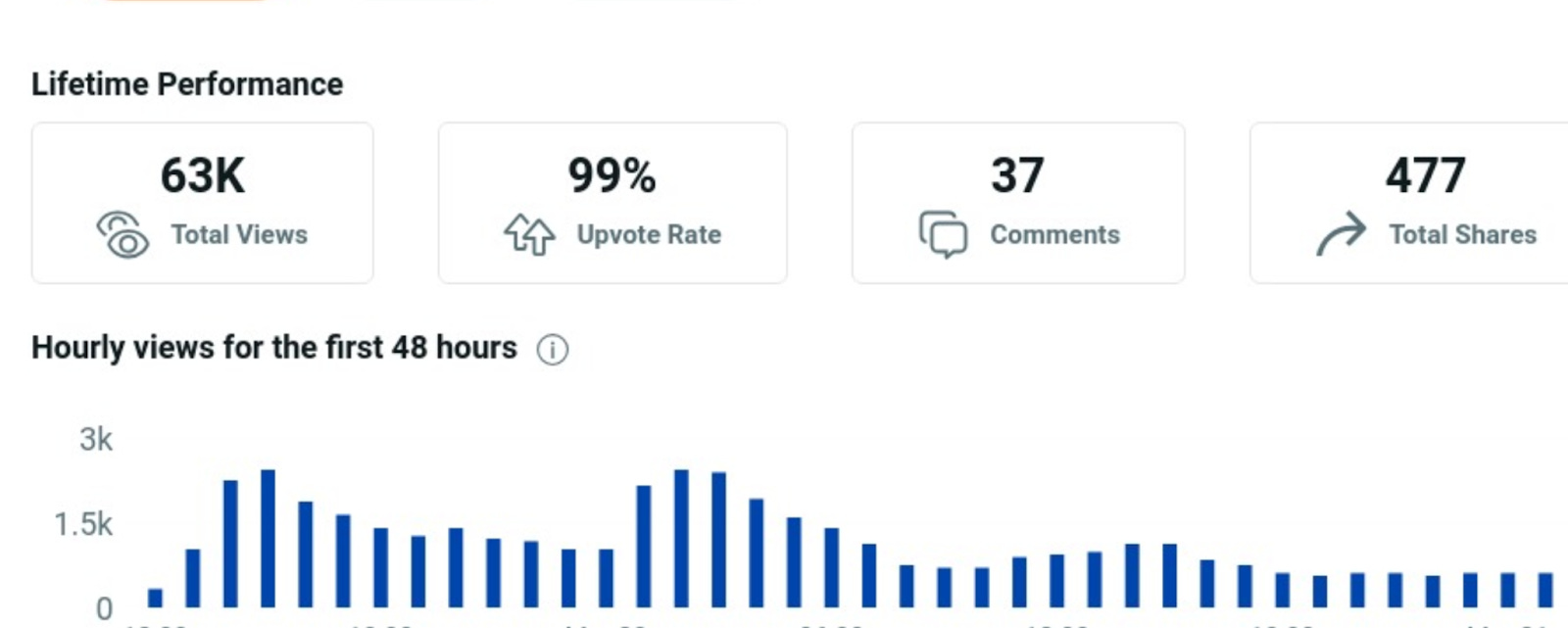
Further strategies:
- Contribute guest posts via influencers/podcasts
- Get newsletter/link roundup features
- Repost on Medium, Substack
- Write LinkedIn articles
- Create LinkedIn/X threads
- Get niche influencers to reshare
3: Write Pillar Pages & Subpages
Create comprehensive content. Unbundle topics into elements or amalgamate fragmented sources with unique perspective.
Example: comprehensive HubSpot growth strategy essay—ChatGPT references this via user queries:
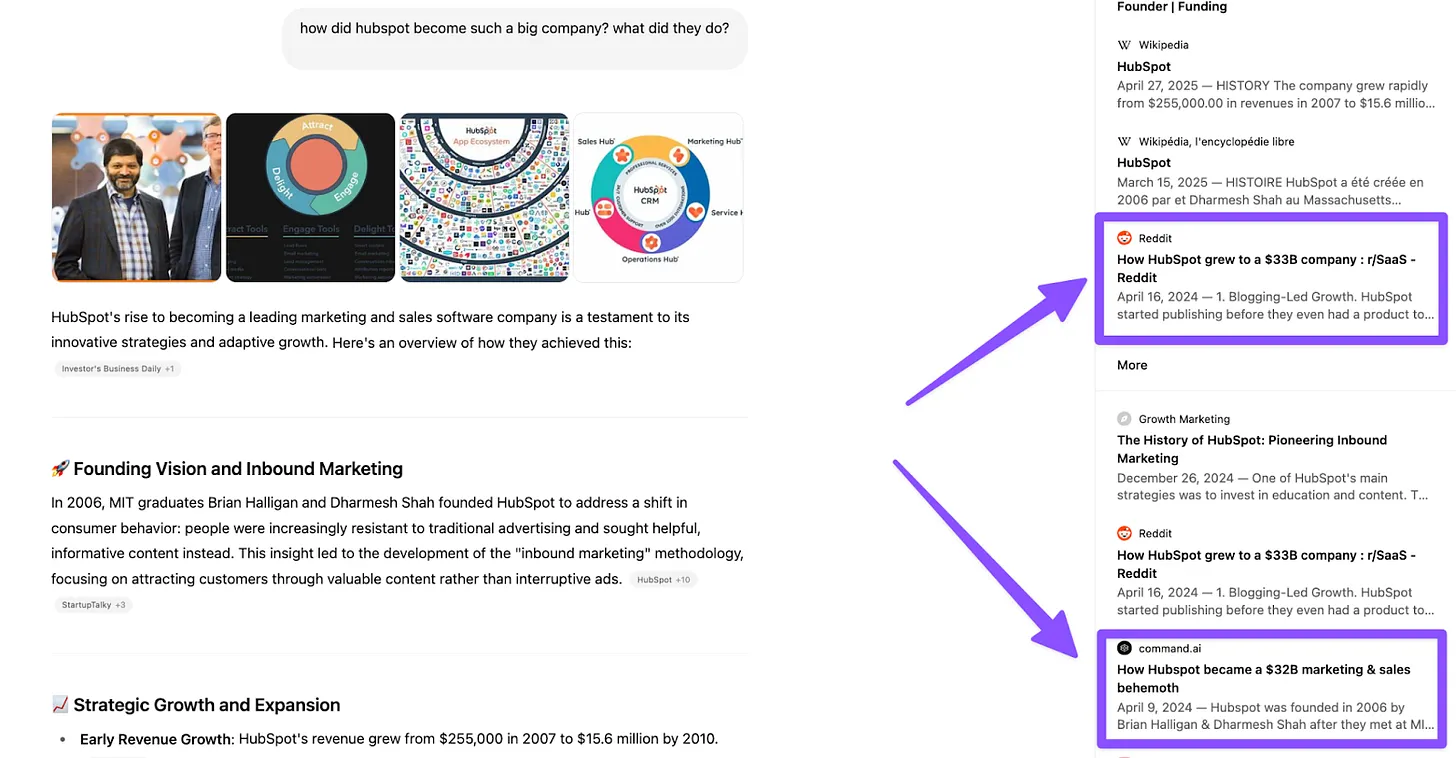
Be comprehensive and add unique perspective to stand out.
4: Be Consistent With Your Messaging
Maintain consistent messaging across webpages and content pieces for LLM ranking.
Example: Coursera ranks for "best online courses" on ChatGPT while Masterclass doesn't. Coursera uses "free online courses" consistently across pages.
Contradictory messaging confuses AI—saying you're best for founders on one page and designers elsewhere signals you're best for nothing.
What Type of Content to Create for LLM Rankings
With pickup methods established, determine specific content topics. This differs from keyword research—optimize for conversational user intent.
The Four Types of User Intent
| Intent Type | Description | Example |
|---|---|---|
| Informational | Finding definitions/learning | "What is an AI agent?" |
| Navigational | Finding specific webpages | "Slack Pricing" |
| Transactional | Purchasing/completing actions | "I want to buy a gaming laptop" |
| Commercial | Pre-purchase research | "What are the best product onboarding companies 2025" |
1: Create Questions Related to Your Brand
Decide which user type you're targeting. Ask Perplexity these questions—it returns summaries with links. Page bottoms show related user questions.
2: Choose Prompts You Want to Rank For
Select target prompts (example: "best linkedin scheduling software for creators"). Break into components:
- Question identifier: what, why, how
- Qualitative element: the best, the top
- Feature identifier: email marketing
- Niche/industry/use case: for creators
Ask ChatGPT/Perplexity: "What are the most common questions {YOUR ICP} ask nowadays about {topic/main keyword}. Provide 10 well-structured questions."
Optimize for follow-ups. If users ask "What's the pricing?" have conversion-ready pricing pages for AI reference.
3: Scour Reddit to Find Content Ideas
Find recurring niche questions on relevant subreddits and answer them (resharing to Reddit). This reflects product marketing clarity—better customer and JTBD framework understanding drives LLM favorability.
Proven Content Formats That LLMs Love
1. Share Exclusive Research & Data
For B2B, interview subject matter experts, research strategies, create premium playbooks. Produce editorial-style newsletters. Companies doing this: Hubspot, Clay, Amplitude, Typeform, Command AI.
2: Repurpose for Socials
Content creation isn't complete until repurposed. Convert newsletters to social posts—LLMs crawl LinkedIn/X posts and articles.
3: Have Dedicated Landing Pages for Each Feature/Use-Case
Optimize home pages/landing pages for LLM ranking. Use user intent-resonant language. Find long-tail intent queries ("best ai ad UGC platform for B2C apps"). Dedicated landing pages help LLMs scrape content.
4: Create Comparison Pages & BOFU Articles
Offer unique perspective showing target audience, competitive advantages, and why targets chose you.
5: Ship Case Studies
For B2B industries, add numerous site case studies. Correlation exists between case study count and LLM rankings.
6: Do Programmatic SEO
Create niche-specific dedicated landing pages/posts giving LLMs context on offerings.
7: Partner With Influencers
Brand appearances in "best of" listicles improve ranking. Partner with relevant bloggers/newsletters.
Writing Guidelines to Get Picked Up by LLMs
Danny Sullivan (Google Search Liaison) confirmed at Search Central Live NYC that AI Overviews are rewriting search rules.
The basic SEO blog post era is over. Win with content AI can't summarize in snippets. Need original research, expert insights, unique frameworks.
- Write like an answer. Use question-based H2s (What is X + how does Y work) with answers in first 1-2 lines.
- Use bullets/numbered lists with definitions and examples.
- Offer unique POV. Be comprehensive.
- Add quotes and cite sources.
- Use FAQs whenever possible.
- Include trending topics/current events references in your industry.
- Answer questions fast—deliver answers in opening sentences.
- Eliminate fluff.
- First sentence after headings should answer the heading.
- Avoid modal verbs (will, should, etc).
- Place key attributes early in sentences. For "What is PLG?", lead with "PLG is a growth motion where the product..."
- Structure content like databases not novels.
- Periodically refresh content even if evergreen.
- Write explicit problem-solution syntax showing clear thought.
- Always add context, quotes, examples.
- Keep straightforward—if content fits one chunk, it's more likely used.
Tools to Track Your Brand's LLM Rankings
| Tool | What It Does |
|---|---|
| Profound | Store LLM ranking sources in real time |
| Semrush AI Toolkit | Compare brand mentions vs competitors, perception, intent, improvement insights |
| Knowatoa | Track whether LLMs reference your brand vs competitors |
| Omnia | Identify most-searched AI engine topics, see competitive ranking |
| Rankscale | Analyze AI Search Visibility, track results, get recommendations |
| Graphite | Query results showing which brands LLMs mention |
| Unify's AIO Checker | Input company, pick keywords, see mention/citation frequency |
Final Thoughts
In Aldous Huxley's words, it's a brave new world. We stand at a pivotal moment.
There will be losers and winners. It's our choice which side of history we join.
Ready to increase your ChatGPT visibility?
Book a call and we'll show you exactly where you stand in AI search — and how to fix it.
Increase Your ChatGPT Visibility →